


Forces Children Scotland 10 hours ago
This article was first published in the Remembrance Day edition of Attention! Magazine. Read the issue here.
Since its publication, three more local authorities have pledged their support for Forces children’s rights.
We’re grateful to the partners who enable this work across the Armed Forces community: Greenwich Hospital, Army Central Fund, Army Benevolent Fund, and The Scottish Veterans Fund.
Across Scotland, a growing number of local authorities are putting the rights of children from Armed Forces families on the record. Six councils—Inverclyde, Renfrewshire, Angus, Scottish Borders, Moray and Midlothian— have now formally adopted the Forces Children’s Rights Charter, representing more than a quarter of Scotland’s Armed Forces children.
The charter was created by Forces Children Scotland, working hand in hand with children and young people from Regular, Reservist and Veteran families. Built on the UN Convention on the Rights of the Child, now part of Scots law, it sets out in young people’s own words what they need for their rights to be respected, protected and supported. Provisions set out in the charter cover many aspects of these young people’s lives, from health, education, housing and their unique Forces identity.
Crucially, it was written by young people rather than for them: “It allowed us to have our say on the importance of children’s rights,” said Erin, one of its contributors. Another young person described it as a record of their “ideas, stories and vision for the future.”
That matters because Forces children are often lesser heard voices. Frequent moves and long separations make them resilient and adaptable, but resilience doesn’t mean they don’t need support. Too often, their experiences go unnoticed in classrooms and council chambers alike.
Inverclyde led the way in June, when Armed Forces Champion Cllr Graeme Brooks’ motion was backed unanimously. Others quickly followed. In Renfrewshire, Provost Lorraine Cameron told colleagues: “We value these young people, understand their experiences, and are committed to ensuring their rights are recognised and respected”.
For some Councillors, the issue is personal. Angus Champion Cllr Ronnie Proctor, a former Black Watch Major, reflected that his own children might have had a smoother path through education had the charter existed then. In Midlothian, Cllr Pauline Winchester, whose father served in the Royal Artillery, recalled living in eleven homes across five countries and attending five primary schools in six years. “Children born into a forces family have a unique life,” she said.
These Councils are committing to raising awareness of Forces children’s needs across their services, promoting the charter through schools and community partners, and working with Forces Children Scotland to turn its principles into action.
With 26 local authorities still to sign, the campaign is far from over. Forces Children Scotland is urging every council in Scotland to follow suit, and every Armed Forces Champion reading this to take the charter back to their own chamber.
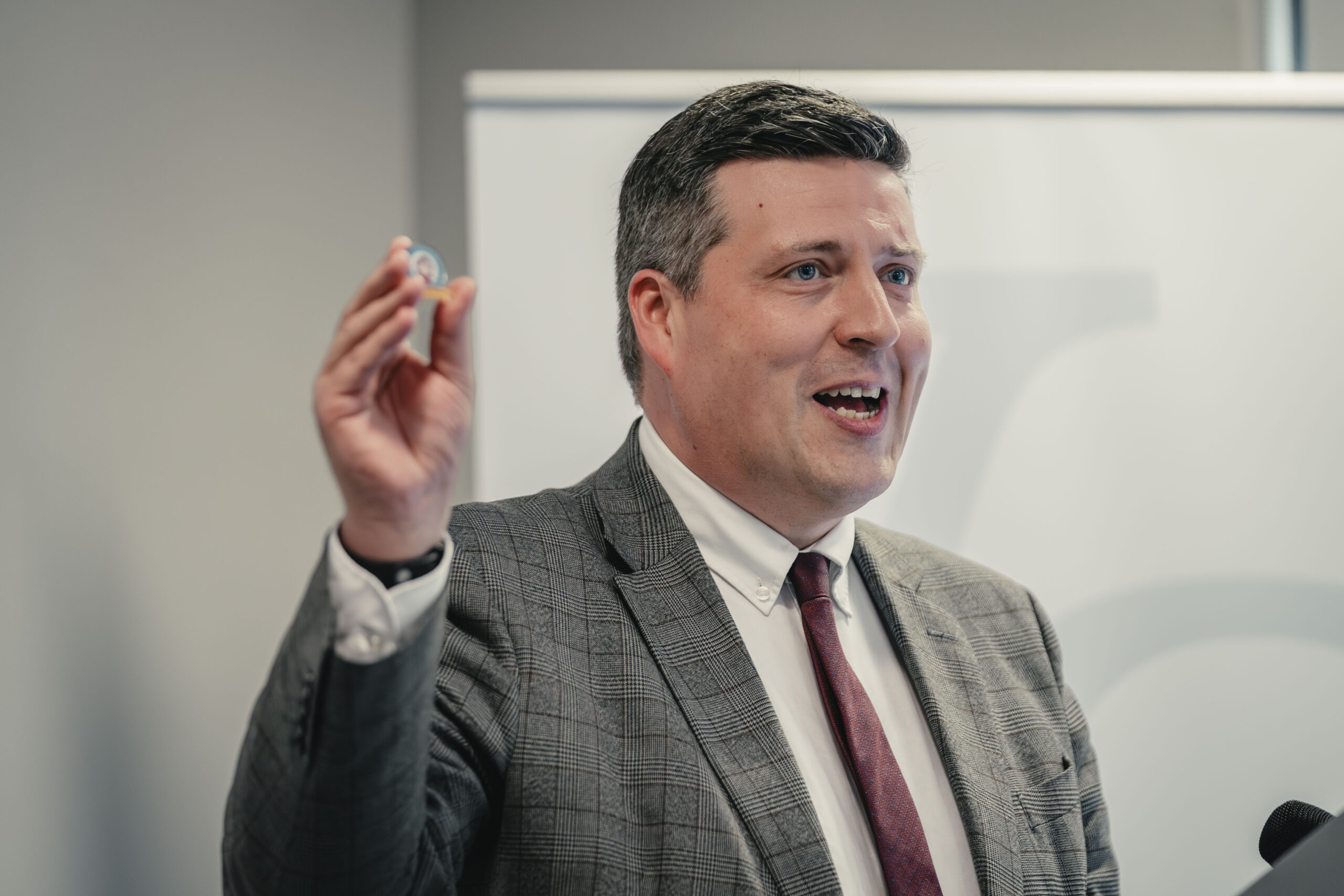 Jamie Hepburn MSP wielding a Forces Children’s Rights Defender badge and vocalising his commitment to the cause at the Veterans Scotland Armed Forces Champions Gathering (photo courtesy of Veterans Scotland).
The City of Edinburgh Council has marked a milestone in strengthening the rights of children from Armed Forces families across...
East Ayrshire Council has endorsed the Forces Children’s Rights Charter, committing to recognise and respond to the needs of children...
We’re working with young people from Armed Forces families to design an interactive digital map and information hub for others...
Perth & Kinross Council has endorsed the Forces Children’s Rights Charter, after two young people from a Veteran family told...
We’re proud to share that we’ve been awarded the Employer Recognition Scheme (ERS) Silver Award, the second-highest honour the Ministry...
This week, the Career Transition Partnership (CTP) launched a pilot Family Transition Pack in Scotland. We’re so excited about this...
Happy National Cadets Week! This is the first-ever National Cadets Week, running 5-11 October. It’s a chance to celebrate cadets...
Midlothian Council has become the latest local authority to adopt the Forces Children’s Rights Charter. Cllr Pauline Winchester brought the...
Moving somewhere new is a big deal, and for children and young people from Armed Forces families, it can happen...
We’re so excited to share this report with you, highlighting the difference we have made for babies, children and young...
For many children and young people in Armed Forces families, global conflict and instability don’t feel like distant issues. These...
Today, Moray Council agreed to endorse the Forces Children’s Rights Charter and continue building on the success of the Dandelion...
Last week, we introduced a Rights-Informed Public Health Approach. Here are some ideas from our CEO, Steven Sweeney, on how...
In the words of Cadence, a young person who contributed to The Forces Children’s Rights Charter, “this is more than a...
Ask a child from an Armed Forces family about relocating and they are unlikely to talk only about moving house. They will describe...
This is a three-part series exploring how a Rights-Informed Public Health Approach (RIPHA) can support continuity of wellbeing for babies,...
Forces Children Scotland congratulates Andy Burnham on becoming Prime Minister. As he begins to set out his policy priorities, our...
Young people from across Forces families had a fun and productive summer residential last week in collaboration with Young Scot....
You may have seen the Ruby Boots poster by now, but do you know the story behind it? Here are some...
We are saddened by the recent loss of Malcolm Noble, our former Chair and dedicated Ambassador. As a team, we...
We're delighted to share that Forces Children Scotland has been named a Defence Employer Recognition Scheme (ERS) Silver Award winner....
Angus Council has today signalled its commitment to the Armed Forces community by becoming the first local authority in Tayside...
Scottish Borders Council has become one of the first local authorities in Scotland to formally adopt the Forces Children’s Rights...
Today, we’re marking our fifth anniversary as Forces Children Scotland, and we had a fitting celebration over the weekend:...
Renfrewshire Council has marked a milestone in strengthening the rights of children from Armed Forces families across Renfrewshire by endorsing...
Here is a summary of our response to the UK Government’s Growing Up in an Online World consultation, courtesy of...
Inverclyde Council has today become the first local authority in Scotland to endorse the Forces Children’s Rights Charter, marking a...
As proud members of Veterans Scotland, we were delighted to attend the Armed Forces Champions Gathering in Stirling last week...
This Volunteers’ Week, we’re feeling grateful to the wonderful team that makes Ruby Boots possible, including Louise, whose compassion and...
In April, we introduced you to Sergeant Scott Urban, who shared why he chose to run the Edinburgh Half Marathon:...
As Communications and Marketing Officer, I produce a lot of content for our website and other channels, but I couldn’t...
This Mental Health Awareness Week, the theme is Take Action. Meaningful action starts with understanding what we may be missing. Forces children often...
A new free, one-to-one online tutoring service for young people from serving Royal Navy, Royal Marines and Royal Fleet Auxiliary families...
Young people aged 11-17 are invited to take complete a 20-30 survey and take part in this research project about...
As Camouflaged in the education system makes clear, children and young people from Armed Forces families are too often present, but unseen: their unique experiences are overlooked in systems that aren’t yet designed with mobility,...
We’re happy to be one of 11 projects helping Forces families feel at home after a move, thanks to funding...
Robert Reid recently joined Forces Children Scotland as a Policy and Campaigns Officer and is working to champion the rights...
Continuing our series on real-life Forces children’s experiences, here are some reflections from young people involved in our participation work,...
Lesley Ure, Community and Service Lead at King’s Group Academies, recently organised a collaborative event in Helensburgh around Scotland’s Schools:...
In this blog, we will look back at a few memories which have stuck with Forces children to celebrate the...
Meg Thomas, our Deputy CEO and Policy Lead, shares some thoughts from a Parliamentary event celebrating Month of the Military...
This May, Sergeant Scott Urban is running the Half Marathon in Edinburgh and raising money to support our work. Here...
Forces Children Scotland warmly welcomes Former Air Commodore Polly Miller-Perkins CBE to her new role as Armed Forces Commissioner. As...
Last month, Judith (our Learning and Development Worker) and Nina (our Participation Manager) were out on the road delivering our...
As we approach Month of the Military Child, it’s critical we learn from the voices and views of children and...
Let’s work together so children and young people’s voices are heard, and their rights are respected, in Scottish schools. As...
One key recommendation from our jointly produced report on Forces children’s education is to embed children and young people’s participation...
We’re grateful to be among the organisations receiving funding from the Scottish Veterans Fund 2026-27, which was recently announced by...
Children from Armed Forces families grow up with experiences that most of their peers and teachers will not understand firsthand....
What is one small, realistic step we can take to help create a fairer future for young carers from Forces...
Even with the best intentions, participation can be challenging to put into practice. Hear from our participation team about practical...
Recently, we took a step back from our day-to-day work to think about the bigger picture – with help from...
Our participation team is excited to be co-producing a unique resource supporting the wellbeing of younger children while their parent or loved one is deployed. With support from the Armed Forces...
How can we meet the needs of the Royal Navy and Royal Marines community? First and foremost, by better understanding...
Louise, a Ruby Boots Volunteer Facilitator, attended a two-day training course to gain skills and knowledge about how to handle...
Marking Place2Be's Children's Mental Health Week 2026, here are some reflections from Deputy CEO and Policy Lead Meg Thomas about...
Children and young people have a right to be heard and taken seriously, but what does this mean, and what...
At the most recent SCiP Conference, we saw children and young people take the floor, commanding the attention of over...
Public speaking is no easy task, let alone to a conference with over 100 delegates. Seeing children and young people...
As 2025 comes to a close, we’re privileged to reflect on what the past year has meant for us and...
Here are some reflections from Annabella Alovatti, a Volunteer Facilitator for The Ruby Boots Project and an undergraduate student of...
Remembrance is both collective and deeply personal. It connects us to the sacrifices of previous generations while inspiring us to...
The theme of Befriending Week this year is Collaboration and Partnership. Heather Douglas, coordinator for the Ruby Boots Project, discusses...
This year marks the first in our partnership with Greenwich Hospital, and we’re proud to celebrate what we have accomplished...
We’re happy to share our principles for the meaningful participation of babies, children and young people. Here are some thoughts...
We are so pleased to share that the co-developed, forces-life-specific Talking Mat is now available to children and young people....
Scottish Children’s Health Week is a time to reflect on what it really means for every child to have the...
Here is some feedback from the Ruby Boots summer sessions, plus practical tips for making wellbeing boxes with children and...
We are delighted that Forces in Mind Trust has awarded funding to this research project exploring how children and young...
Earlier this month, we brought a group of 14 young people from forces families together in Edinburgh for an action-packed...
We can provide financial support to empower young people from Regular, Reservist and Veteran families to realise their potential.
We’re proud to share the impact of our recent learning sessions delivered to teachers at Colinton Primary School in Edinburgh!...
Wesley, a former British Army soldier, completed the 2025 Edinburgh Marathon and raised almost £800 for Forces Children Scotland.
Article 31 of the UNCRC says that every child has the right to relax, play and take part in a...
Jaiden, Sophia, Meg, and Robyn delivered a workshop on Forces Children Scotland’s Children’s Rights Report ‘It’s not just their job,...
Policy catch-up with Robyn Pattinson Meet Robyn, who is our Policy and Parliamentary Officer at Forces Children Scotland. Robyn tells...
Attend our SCiP Conference Workshop We’re attending the SciP Alliance Conference in Cardiff to present a workshop on Forces Children...
Response to government announcement concerning the Hayward Review Forces Children Scotland is extremely disappointed by the Scottish Government’s decision not...
Forces Young People meet with the Minister for Children, Young People, and The Promise Six young people, representing the Navy,...
Forces Children Scotland joins over one-hundred charities and organisations in signing a letter demanding the Scottish government fulfil its promise...
The Scottish Government’s Programme for Government outlines its strategic priorities and legislative agenda for the coming year, focusing on key...
Scotland has incorporated the United Nations Convention on the Rights of the Child into Scots Law. The United Nations Convention...
Scotland has incorporated the United Nations Convention on the Rights of the Child into Scots Law, within the limits of...
A talented young Fife artist has designed a captivating series of animated characters for Forces Children Scotland’s Children’s Rights Report...
Looking at forces life through a children’s rights lens We are delighted to launch our children’s rights report to highlight...
Scottish Youth Parliament #SYP81 Representation Rubie and Chloe represented the lived experiences and views of young people from forces communities...
Children’s Rights from forces children’s perspective – Reflections by Meg Thomas, Deputy CEO & Policy Lead. We recently held a...
Young Carers Action Day 2024 This year’s theme promotes a fair future for young carers. Young Carers Action Day is...
Forces Children Scotland is delighted to become an Associate Member of the Scottish Youth Parliament. The announcement follows the recent...
Forces Children Help Shape Future Children’s Rights Landscape in Scotland. Forces Children Scotland worked in partnership with Queen Victoria School...
A response to the Scottish Veterans Commissioner (SVC) report ‘Community and Relationships: Anything but Uniform’. Forces Children Scotland welcomes the...
Today has proved very significant regarding children’s rights in Scotland. The Scottish UNCRC (Incorporation) Bill has received Royal Assent &...
Introducing our new Deputy CEO and Policy Lead, Meg Thomas. Meg will lead our exciting policy work, following the release...
Upholding Children’s Rights is fundamental. Children and young people can be one of the most vulnerable groups in society, so...
We have combined forces with young people from the armed forces community to co-develop our influencing strategy and manifesto. Working...
We have combined forces with young people from the armed forces community to co-develop our influencing strategy and manifesto. Working...
We have combined forces with young people from the armed forces community to co-develop our influencing strategy and manifesto. Working...
We have combined forces with young people from the armed forces community to co-develop our influencing strategy and manifesto. Working...
We have combined forces with young people from the armed forces community to co-develop our influencing strategy and manifesto. Working...